Heater Hose Replacement
What is a heater hose?
Heater hoses carry engine coolant from the engine to the heater core. There is one inlet hose, and one outlet hose. On older vehicles, the inlet hose may be split into two segments, separated by a heater control valve.
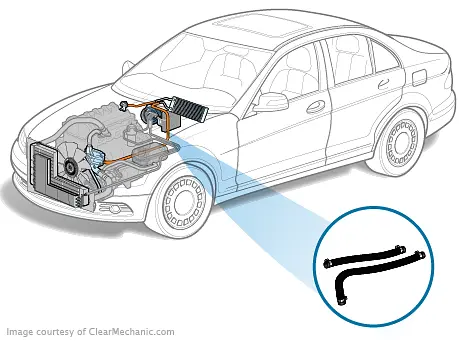
How does the heater hose work?
All engine cooling system hoses work the same way. They are pressed onto a connector at both ends, and either clamped, or sealed with an O-ring type seal. This provides a watertight seal between the two components being connected.
Coolant hoses can be damaged by oil leaks. The issue should be addressed in order to avoid damaging the new hoses.
What are the symptoms related to a bad heater hose?
A failing heater hose may cause the vehicle to smell of engine coolant under the hood. If coolant runs onto the heater core inlet or outlet, the cabin could begin to smell of coolant and mildew. Also, the engine may being to run increasingly warmer until the vehicle is repaired. Coolant may leak onto the engine, firewall, and ground, as a defective hose may swell and burst. The worst-case scenario is engine overheating, and possible cylinder head gasket failure.
Can I drive with a heater hose problem?
If the heater control valve is leaking, it is not advised to drive the vehicle as overheating can result from any coolant leak. In this situation, towing the vehicle to a repair facility is the best course of action. When the heater control valve is simply unresponsive, it will not affect drivability in any way, but passenger comfort may be negatively affected.
How often do heater hoses need to be replaced?
Hoses are considered “wear and tear” items, and are expected to be replaced at least once over the life of the vehicle. They tend to fail more quickly if the cooling system is not properly maintained according to the manufacturer's’ scheduled maintenance intervals.
How are heater hose issues diagnosed?
Heater hoses must be replaced when, at any position on the hose, there is an engine coolant leak or obvious swelling. Also, replacement will be recommended if the hoses are cracked, or worn down by prolonged contact with warm or vibrating engine components.
How is a heater hose replaced?
The coolant is drained from the engine in preparation for servicing the engine cooling system. Clamps will be removed from the ends of the hoses, and the hose will be removed from the heater core and engine. The inlet and outlet flanges on the heater core and engine are cleaned in preparation for installation of the new hoses.
If the vehicle has a heater control valve attached to the heater hoses, they should all be replaced at the same time.
We recommend using molded coolant hoses rather than "universal" hoses. Universal hoses can be deformed by pressure and heat and are prone to failure earlier than hoses designed to fit your vehicle.