CV Boot Replacement
What is a cv boot cover?
A half shaft—also called an axle—transmits power from the transmission to propel the vehicle's wheels. Each half shaft has two constant velocity (CV) joints, which are packed with grease and encapsulated by a rubber cover known as a CV boot. This rubber boot helps to keep grease in the CV joint, and to keep from dirt and debris from contaminating the joint.
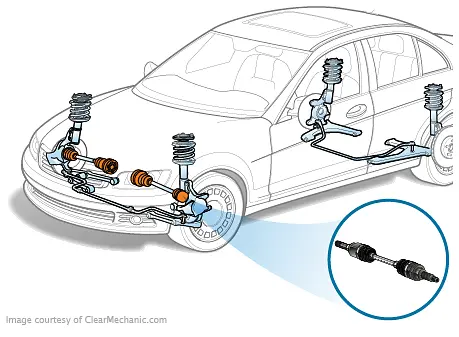
How does the cv boot cover work?
Independent suspension vehicles use constant velocity (CV) axles that have articulating heads at both ends, allowing the wheel to move independent of the differential or transmission. The CV joints at the ends are enclosed in a thick rubber material, called the “CV boot”, that prevents grease from escaping, and dust from entering.
Due to high labor costs, it may be economical to replace the entire axle rather than just the CV boot. Ask for the parts and labor costs for both repairs before deciding.
What are the symptoms related to a bad cv boot cover?
The symptoms of a drive axle leak are very clear. For CV axles, the leakage even easier to spot, as axle grease will coat everything around the torn boot. If the transmission or differential output seal is leaking, the axles may sling that fluid around the wheel wheel and undercarriage while driving.
Can I drive with a cv boot cover problem?
Driving with a CV boot leak is not particularly dangerous or hazardous to the vehicle, unless the boot has been leaking excessively. If the leak has been present for long enough, the leaking CV axle is in danger of mechanical failure. The vehicle should be driven carefully if the CV axles being popping while driving through turns, or over bumps. As the problem develops, the CV axle will eventually stop driving the wheel.
How often do cv boot covers need to be replaced?
Driveline leaks and seepage from CV boots, wheel seals, differential seals, and transmission output seals will occur at some point in a vehicle's serviceable lifetime. Most CV boots tend to last around 80,000 to 100,000 miles, but driving habits can dramatically influence this range in either direction.
How are cv boot cover issues diagnosed?
Inspecting for leaking CV boots is very straightforward, diagnosis only requires simple observation while the vehicle is on a lift. If any leaking or seepage is detected, the seal or boot must be changed.
After the repair, if there are any "clicking" sounds when making turns, return to the shop to have them further address the problem. It's likely that the CV joint needs to be replaced.
How is a cv boot cover replaced?
CV boot replacement requires the wheel and the lower ball joint to be removed to free the CV axle. Then the CV boot or output seals can be replaced , and the CV axle may be re-installed. If the CV joints are popping while the vehicle is turning, the CV axle may require complete replacement. Then the ball joint can be installed and the axle nut can be torqued to specification.
We recommend replacing both CV boot covers on the CV half shaft to save on repeat labor charges if the second boot cover were to fail.