Axle Shaft Replacement
What is a front axle?
The front drive axle is responsible for transmitting power from the transmission or differential to the wheel hub. There are two types: straight axles and constant velocity (CV) axles.
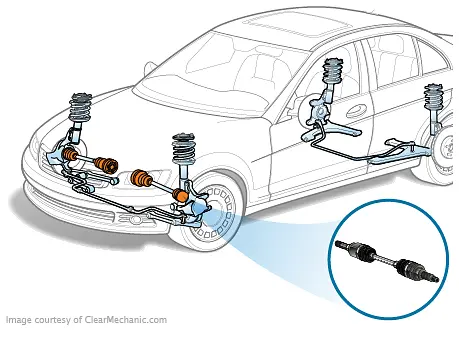
How does the front axle work?
Front drive axles are made of strong metal in order to withstand transmitting power from the engine to the wheels and carrying the weight of the vehicle.
They have geared ends called “splines” that mesh with the differential and the hub-and-bearing assembly. Straight axles spin inside of a tube called the axle housing, which contains the differential in the center, the right and left axles, and the wheel bearings. Unlike a straight rear axle, the front axle must bend to allow the wheel to turn. This bending is accomplished using a universal joint.
Independent suspension vehicles use CV axles, which have articulating heads at both ends, allowing the wheel to move independent of the differential in all directions. The CV gears at the ends are enclosed in a thick rubber material, called the CV boot, that prevents grease from escaping and dust from entering.
CV axles have become far more common to see in modern passenger vehicles, while straight axles remain dominant in heavy duty applications.
A "clicking" noise when turning can be from a failing CV joint. In many cases, the CV axle shaft will need to be replaced.
What are the symptoms related to a bad front axle?
When a straight axle fails, it may cause vibration while driving. If the wheel bearing has failed, the axle and bearing will make a grinding noise while you drive. This may be accompanied by vibrations in the steering wheel and brake pedal.
Can I drive with a front axle problem?
No, driving with a faulty axle or wheel bearing is dangerous. Aside from the vehicle feeling unstable, the wheel may come off when the bearing completely disintegrates. If you hear mechanical grinding from the wheel bearing, stop driving it and get it repaired.
» TAKE ACTION: Get this fixed by a RepairPal Certified Shop
How often do front axles need to be replaced?
Straight axles tend to fail less often than CV axles because of their heavy-duty nature. The typical front CV axle should last between 80,000 and 100,000 miles, but your driving style can significantly increase or decrease service life.
How are front axle issues diagnosed?
Diagnosis starts with a visual inspection and test drive. If symptoms point to a faulty front axle, the axle will be inspected for damage, and the CV axles will be replaced. If the visual inspection revealed torn CV boots, but no damage is evident to the CV gears, the CV boot may be replaced.
For straight axles, the wheels may be turned by hand before removing the axle for inspection. The bearing and axle will be examined, and if damage is present where the axle meets the bearing, they must both be replaced.
A warped straight axle is diagnosed using a straight edge, and can be evident from wear patterns.
After the repair, if there are any "clicking" sounds when making turns, return to the shop to have them further address the problem. It's likely that the CV joint needs to be replaced.
How is a front axle replaced?
For CV axles, the wheel, axle nut or axle bolt, brake caliper, brake caliper mounting bracket, and brake rotor must be removed. Then, the most advantageous suspension component is disconnected from the steering knuckle to allow the CV axle to slide free from the bearing and hub assembly. The CV axle is then removed from the transmission or differential, and the new shaft will be installed in the reverse order.
For straight axles, removal of all the same components is necessary, with the addition of the differential cover. This cover must be removed to disconnect the drive axle from the differential. The differential will be cleaned, inspected and resealed when the new axles are installed.
An axle half shaft replacement is often recommended if the part has been removed during another repair and inspection shows that it is worn and due for replacement.