Suspension Shock or Strut Replacement
What is a Suspension Shock or Strut?
Most passenger cars, trucks, and SUVs today feature an integrated steering and suspension system. At the heart of the suspension is the strut assembly, a mechanism that combines a shock absorber and a coil spring into one unit to absorb bumps in the road and to keep the tires in contact with the ground at all times. The top of the strut is also used as the upper pivot point of the steering system. While this is most common, many vehicles past and present still use a shock absorber instead of an integrated shock and strut. These work in exactly the same way, except they are independent of the coil spring.
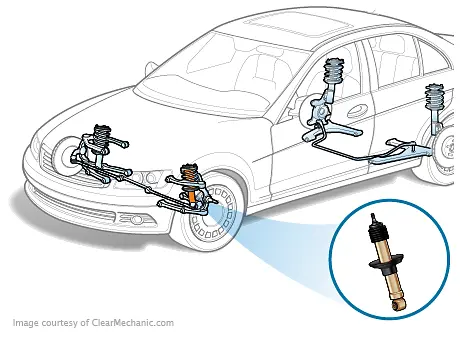
How do Suspension Shock or Struts work?
There are many components that make up the steering and suspension systems on a vehicle. The wheel is bolted to a wheel hub that turns inside bearings set in the steering knuckle. The knuckle, in turn, is connected at the bottom to a moving bracket called the lower control arm, and at the top to the strut and possibly an upper control arm. The steering gear is attached to the knuckle by way of the tie rods so that when the steering wheel is turned, the knuckle turns with it, rotating on the lower control arm and the upper strut mount. The strut assembly, widely known as a MacPherson strut, is made up of a special shock absorber, a coil spring, and the rotating upper strut mount and bearing assembly. Additionally, vehicles using shock absorbers instead of struts will have the shock mounted to the chassis and the lower control arm. This allows the shock absorber to moderate the movement of the coil spring, preventing the vehicle from bouncing up and down indefinitely.
Shock absorbers can require replacement due to oil leaks, knocking noises, and torn rubber bushings.
What are the symptoms of a bad Suspension Shock or Strut?
Because the suspension struts and shocks control the entire weight of the vehicle, they can wear out over time. The shock absorber is usually the first to go. When this happens, the ride quality becomes "bouncy" or loose, and the vehicle's ability when cornering in a turn diminishes. Oil may be seen leaking from some types of struts and shock absorbers. Also, since the upper mount is constantly being turned or compressed, it will eventually break down and squeak of clunk over bumps and during turns. For struts, a clicking or growling noise when turning can indicate a worn bearing inside the upper strut mount, and a squeaking sound when the steering wheel is turned can mean that the rubber bushings in the mount are decaying as mentioned. Also for struts, the coil spring can break and cause a loud clunking sound when turning or when going over bumps.
Can I drive with a bad Suspension Shock or Strut?
Suspension struts and shocks may or may not fail all at once. And each of its members do not fail equally. The decline is gradual and may be difficult to notice at first. A vehicle with worn struts or shocks can be driven, but the ride quality will be diminished. More importantly, the vehicle's handling will be compromised. A car's ability to remain level while turning, with traction spread between all four wheels, is dependent on the struts or shocks, and as the condition of the suspension struts and shocks worsens, the ability of the suspension to perform properly also worsens - especially in an emergency situation. Loss of control and chance of vehicle rollover can be the result of severely worn struts and shocks. If a strut or shock absorber shaft is broken or bent, the vehicle should not be driven until it can be replaced.
How often do Suspension Shock or Struts need replacement?
There is no replacement schedule for most suspension struts and shocks, through many vehicles will need to have them changed at some point. Rough driving habits may shorten the life of these parts. Struts and shocks may need to be replaced anywhere between 50k and 100k miles. If at any time the struts or shocks are leaking, broken, or damaged, they should be replaced immediately. Lastly, they should always be replaced as pairs. In other words, if one front shock or strut is replaced, the other front shock or strut should be replaced as well.
How are Suspension Shock or Strut issues diagnosed?
If the vehicle has excessive play in the suspension - if the vehicle bounces easily up and down - the suspension shocks or struts are likely worn. Many times, a strut is diagnosed when a technician is replacing other related parts. A damaged strut may also be discovered during a four wheel alignment. In doubt, a technician will use body weight to bounce the vehicle up and down on each corner, and if the amount of residual movement up and down is excessive, the shocks or struts are worn. Extremely worn shocks and struts are more than obvious while driving, as the vehicle will float up and down after bumps, often bottom out, and lean excessively through turns.
How are Suspension Shock or Struts replaced?
To change a suspension strut, a technician first needs to lift and support the vehicle with a hoist (or a jack and jack stands) and remove the front wheel. The brake caliper and rotor are removed and the sway bar link is disconnected. The technician then disconnects the strut from the steering knuckle and from the strut tower to remove it from the vehicle. If the entire strut assembly is being replaced, installation is relatively simple. On the other hand, it is common to reuse the coil spring from the old assembly. In this case, the worn strut will need to be compressed and disassembled, and the new strut will need to be put together before it is installed. On the other hand, shocks are much easier to change. Most often, removal of the wheel is sufficient to allow the upper and lower mounting bolts to be removed. Once removed, the new shock mount and shock are installed. Once the wheel is torqued, the process is repeated on at least one more shock.
Prior to replacement of the struts/shocks, a full inspection of the steering and suspension should be performed to identify any needed repairs. This will cut down on the labor costs when compared to replacing the worn parts separately.
We recommend a four-wheel alignment when shock absorbers are replaced. The new shocks affect the vehicle's ride height, which will change the wheel alignment.